Showing posts with label Wayback Wednesday. Show all posts

Thursday, 19 June 2014

Wayback Wednesday - The Importance of Ease

I know... it's Thursday.  Late Thursday.  This should have been posted yesterday, but let's pretend it's still Wednesday.

Welcome back to Wayback Wednesday, the day we look back in time at the works of Christine Frederick and other pioneers in home economics.

In New Housekeeping: Efficiency Studies in Home Management, Frederick performs an in-depth review of the ergonomics of washing dishes.  From the height of the sink, to the placement of the tools, to the specific motions of each hand.  The idea being that for work to be performed optimally, it needs to be done with ease.  Physical straining cause by poor ergonomics makes work harder.

Included in her study was a table showing what the proper work surface height should be for people of various heights.

Frederick noticed that many of the working surfaces in her home were not optimized for her height.  This meant that every task she performed was taking more effort than it needed to.  She also tried to ensure that tasks didn't require any unnecessary bending or lifting.  All of these are modern elements of ergonomics for work centre design.
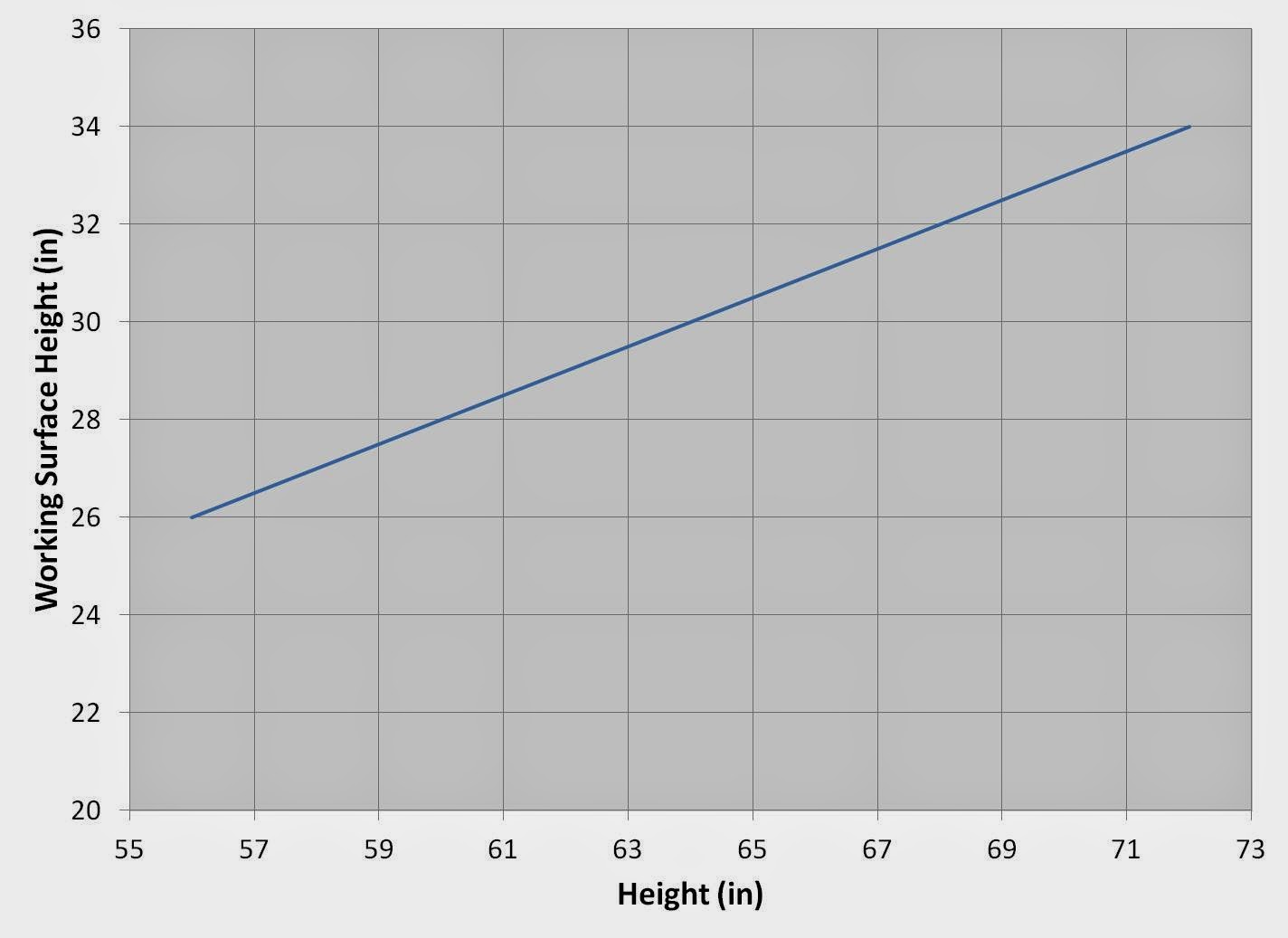
To calculate the correct working surface height, Frederick provided a table and a formula.  I've converted it to a graph here for ease of use.


Ironing is one task that Frederick's suggests would benefit from a proper work surface.  Not only height, but also sturdiness.  She writes;

"In ironing, I found that my boards just like the sink, was not at the right height. It was so high that I couldn't obtain enough purchase on my iron without extra effort. I simply lowered the board, made it very steady, and thus helped my efficiency." (Frederick 1912)

I decided to put her principle of a proper work surface height into practice when I did the ironing this week.  This was a qualitative study, I really should have measured the time it took to iron a shirt with each working surface height.  I might recreate it during another wash day.

Now, I am not a tall person.  Okay, that's probably an understatement, I'm short.  My suggested working surface height is 28 inches.  I have been setting up the ironing board at 32 inches.


The difference can really be seen in the angle of my elbows.  At the lowered working height, my arms are almost straight down at a more natural angle.  At the original height, I had to hold my arms in a bent position.

Sure enough, the lower board felt much more comfortable.  It took less effort, less strength and I was able to finish quicker.  

So how does this compare to present day ergonomic standards?

Ironing these days is very different than ironing in the early 1900s.  Electric irons were just being released.  You were lucky if you had one that was self-heated using coal or gas, these novelties were considered great time savers.  Frederick wrote that an electric iron in 1912 would have cost $6, that is a cost today of almost $150.  Would you spend $150 on an iron??


Needless to say, using a coal heated iron, or a metal one that needed to be heated on a stove is a lot heavier than a plastic one from today.

The Canadian Centre for Occupational Health and Safety has a good graphic that shows the different standing work surface heights for different types of jobs.

http://www.ccohs.ca/oshanswers/ergonomics/standing/standing_basic.html

In this case, heavy work isn't just lifting.  It's defined as work that requires applying a downward force.  It doesn't matter which iron you're using, you need to press down on the iron.

The CCOHS guideline says heavy work should be performed on a surface 7 3/4 - 15 3/4 inches below elbow height, which for average people works out to 25 1/2 - 37 1/2 inches.  My elbow height is about 36 inches off the ground, so a work height of 28 inches falls nicely in this range (for a short person).

So for the last 18 years, I've been setting up my ironing board 4 inches too high.  I'm guessing this is because my father, who is well over six feet tall, taught me to iron.  

I wonder if he knows he was setting up the board two inches too low?

Wednesday, 9 April 2014

Wayback Wednesday - The New Housekeeping Cookbook

Welcome to the first Wayback Wednesday at Ops@Home!

What's Wayback Wednesday you ask?  It's when we take a look at the work of a pioneer home efficiency engineer and see how we can apply it to the 21st century.    Today we're looking at the work of Christine Frederick and her "New Housekeeping Cookbook."

First, a little about Mrs. Frederick.  Christine Frederick was a university educated wife and mother at the turn of the 20th century.  Working in the home, she found that her days of housework and child rearing were leaving her exhausted at the end of her day and not feeling like she had adequately discharged her duties.  She also found she had little time for her own pursuits, socially and intellectually.  Her husband was a business executive who along with his colleagues were interested in how the work of Frederick Taylor and the other efficiency engineers of the day were benefiting businesses.  Mrs. Frederick saw this new science as an opportunity to improve her life and began to conduct Taylorist work studies within her own home.  These experiments became the basis for several publications beginning with "The New Housekeeping: Efficiency Studies in Home Management"

Frederick took "adequate, immediate and reliable records", one of the main tenants of efficiency engineering, and created an elaborate home record system using index cards and file boxes.  Part of this system was what she called the "New Housekeeping Cookbook".   In Frederick's day, recipes were often pasted or written into large scrapbooks which became cumbersome as new recipes were added.  With her New Housekeeping Cookbook system, Frederick attempted to solve three problems;

  1. Recipes difficult to find within the book.  They were added to the next blank page rather than categorized.
  2. Recipes often became soiled as it was on the counter during cooking.
  3. Recipes were tucked in before they were tried, filling with book with potentially horrible food.

First, rather than using a scrapbook, Frederick used a card cabinet and index cards.

Frederick, Christine.  Household Engineering: Scientific Management in the Home. 1923
This allowed her to categorize recipes and easily add new recipes in the right order.  Second, she mounted a piece of glass on the front of the box, protecting the card as it was being used.  Third, she only added recipes to the cabinet after they were tested and enjoyed.  Recipes she wanted to try were kept in a separate file.

My recipe storage system looks like this, a large stack of paper and more back issues of Canadian Living than the waiting room at my dentist.  


This system is not useful for finding anything.  If I want to find a recipe that I've made before I need to remember if it was in the July 2008 or February 2004 issue.  Nor is it really helpful when I'm trying to come up with ideas for meals.

I also have a recipe binder which is full of wonderful things neatly divided into standard categories.  Meat, Fish, Vegetables, Grains etc. 


It has great recipes, like the one for mini eclaires I cut out of a magazine 7 years ago.  I've never made a mini eclaire, but you know... one day.  I never go to the binder when I'm looking for things to cook, except when I do the Christmas baking.  Why?  Because I have to flip through pages of things like Brined Turkey and Steamed Monk Fish to find something I could make in 20mins on a Wednesday night.  It was also so full of recipes I had never tried, there was no room left to add new favourites.

Needless to say, my system needs some work.  Looking at Frederick's system there are definitely some things I can apply.

Rather than using index cards, I'm going to stick with a three ring binder and page protectors.  These provide the same flexibility and protection as the cards, without needing to rewrite or cut and glue recipes.  Plus, I like pictures.

The first thing I implemented is the separate file for recipes I haven't tried yet.  This cut the binder contents down by almost two thirds.  Now every week I pull a new recipe out of the folder and test it out.  If we love it, the recipe gets filed in the binder. If not, it gets filed in the blue bin.  The Trout Provencale en Papillote was a keeper.  The Roasted Eggplant Dip was not.

Turns out a lot of the recipes I've been storing for years (in some cases a decade) weren't really worth keeping.

The second thing I did was change how I stored the recipes.  Frederick sub-divided her Meat category into "Requiring One Hour or Less" and "One to Four Hours".  I took this idea and used the following categories:
  • Weeknights
  • Sides
  • Lunches
  • Occasions
  • Slow Cooker
  • Desserts
  • Baking
  • Other

This way when I'm meal planning I can easily skip passed the Monk Fish and get right to the Vietnamese Beef Pho.

The next step was working through the stack of magazines to actually clip out the recipes I thought were interesting.  I realized a lot of what I was storing were ads and out-of-date fashion advice.  More fodder for the blue bin.  This is still an on going exercise but at least I'm no longer adding new magazines to the pile.

Another idea of Frederick's which I think has a lot of merit are her Menu Cards.  When she planned a menu for a dinner or luncheon and she thought it was particularly successful she wrote it on a card and stored it in a special section.  This meant she wasn't trying to recreate a full menu every time she was planning a party.

What I'd really like to know is if anyone has a way to do this digitally.  Any great ideas that could allow me to retire my scissors?